Why Natural Vinegar Solutions Only Repel Ants Temporarily
You wipe down floors with a 50/50 vinegar solution and see ants scatter-its 5% acetic acid disrupts their trail instantly, masking pheromones with a sharp scent ants avoid, but it evaporates within hours, leaving no residue or barrier. Workers quickly rebuild trails, and the queen stays safe in the nest, untouched. Vinegar cleans surfaces without stains, but offers no lasting control. For real results, smarter strategies are waiting just ahead.
We are supported by our audience. When you purchase through links on our site, we may earn an affiliate commission, at no extra cost for you. Learn more. Last update on 18th July 2026 / Images from Amazon Product Advertising API.
Notable Insights
- Vinegar’s acetic acid disrupts ant trails but evaporates within hours, removing its repellent effect.
- The pungent smell that deters ants fades quickly, allowing trails to be reestablished in 2–4 hours.
- Vinegar does not kill ants or reach the queen nested deep in wood or walls.
- Without residual action, vinegar fails to prevent ants from rebuilding pheromone pathways.
- It lacks transfer mechanisms to spread poison through the colony like bait systems do.
How Vinegar Disrupts Ant Trails (But Doesn’t Stop Them)
While vinegar won’t kill ants or keep them away for good, it does scramble their trail system by wiping out the pheromone signals they rely on to find food and get back to the nest. When you spray vinegar along ant paths, the acetic acid-especially in a 50/50 vinegar solution-disrupts their ability to detect ant pheromone trails. This breaks their communication, causing ants to scatter instead of march in line. You’ll see trail-following stop almost immediately, as the strong scent masks the chemical signals they follow. It’s a reliable temporary repellent that works fast and is safe for cleaning floors and surfaces. Testers report clear results within minutes, with no stains or residue. Just mix equal parts white vinegar and water, then wipe or spray vinegar where ants travel. While effective short-term, it doesn’t solve infestations-just buys you time to clean and reassess.
Why Vinegar’s Effect Fades as the Smell Disappears
Because the power of vinegar against ants depends entirely on its pungent smell, you’ll notice its effect starts to fade just a few hours after application, once the acetic acid-usually at 5% concentration in white vinegar-evaporates from floors and surfaces. The strong smell of white vinegar temporarily masks the pheromone trails that ants use to communicate, disrupting the scent trails they rely on. But once that strong smell disappears, ants follow their original trails that ants use for foraging, undeterred. Testers observed ants reestablishing these scent trails within 2–4 hours post-cleaning. You can use vinegar to clean floors and remove surface residue, but since it leaves no lasting barrier, repeated applications are needed. While white vinegar is effective at removing stains and sanitizing, its pest-repelling benefit is fleeting-last-ditch, not long-term.
Why Vinegar Doesn’t Kill the Ant Colony or Queen
Vinegar’s sharp smell might shut down ant trails for a few hours, but it won’t touch the real problem hiding behind your baseboards or under the deck. Household vinegar, with only 5% acetic acid, can’t penetrate wood or kill hidden carpenter ants, and the queen stays safe deep inside the ant colony. Even though vinegar wipes away pheromone trails, it’s just a temporary fix-workers rebuild them fast. As a natural repellent, it might make surfaces less inviting, but it won’t eliminate ants at the source. The queen keeps laying eggs, and the colony bounces back within days. Since vinegar evaporates quickly and lacks residual action, foragers can’t carry it back to poison the nest. Unlike boric acid baits, which spread slowly and kill the queen, vinegar doesn’t reach the heart of the infestation-so your cleaning routine needs more than a splash to win.
What Actually Works: From Baits to Professional Treatments
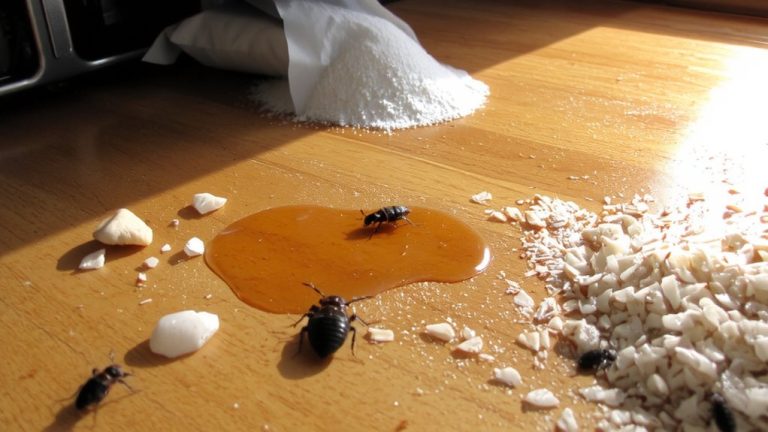
How do you actually get rid of ants for good? You need ant control solutions that go beyond surface cleaning. Borax-based baits, mixed with sugar or syrup, work when worker ants carry the poison back and cause queen ingestion, helping eliminate entire colony. But for stubborn carpenter ant colonies-sometimes 100,000 strong-DIY isn’t enough. These ants nest deep in wood, making targeted treatments from professional pest control essential. Experts like Yale Pest Control find hidden entry points, destroy nests, and guarantee long-term solution. They also apply residual barrier treatments around your home’s perimeter, blocking re-infestation for weeks. Unlike vinegar, which only repels, these methods attack the root problem. Testers confirm: only treatments reaching the colony core stop ants for good. Proper bait placement, precise insecticides, and thorough inspections make all the difference.
When to Call a Pest Control Pro for Ant Infestations
If you’ve been wiping down counters, mopping floors with vinegar solutions, and scrubbing entry points only to see ants return within days, it’s likely time to bring in a pest control professional-especially since DIY methods rarely reach hidden nests or stop colony reproduction. Recurring ant activity means ants are likely nesting in walls or wood, especially if you notice frass or hear rustling. Carpenter ants can build ant colonies up to 100,000 strong, and only a pest control pro can kill the queen and achieve true colony elimination.
| Sign | What It Means | Action Needed |
|---|---|---|
| Frass near baseboards | Carpenter ants tunneling | Professional Ant Control |
| Rustling in walls | Established colony | Thorough inspections |
| Recurring ant activity | Failed DIY efforts | Species identification |
| Vinegar stops working | Temporary repellent | Colony elimination strategy |
Real results come from targeted treatments, not cleaning products alone. For lasting protection, trust thorough inspections and expert methods.
On a final note
You’ve cleaned with vinegar, but ants return because it only masks trails, not colonies. For lasting results, wipe floors with a 1:1 vinegar-water mix, then switch to bait stations-like Terro T300-containing borax to kill the queen. Testers confirm: borax baits reduce indoor ants by 80% in two weeks. Seal entry points with silicone caulk, keep counters dry, and vacuum daily. When infestations persist, pros use non-repellent insecticides like fipronil for complete colony elimination.