How to Use Non-Repellent Insecticides to Break Ant Recruitment Cycles
You break ant recruitment by spraying non-repellent insecticides like Termidor SC or Phantom along foundation walls, expansion joints, and entry points every 3 to 5 feet. Ants walk through the treatment and carry the undetected toxin back, spreading it via grooming and trophallaxis. Clean surfaces first with a water-based cleaner to remove trails, then apply Alpine WSG or Advion MicroFlow for invisible barriers. Combine with InTice 10 bait at 1 lb per 1,000 sq ft to boost kill rates. Reapply monthly-outdoor residuals fade by 30 days-for sustained transfer and colony collapse. Field tests show 95% less activity within 90 days when done right. There’s more to optimizing this strategy where timing and tool alignment make all the difference.
We are supported by our audience. When you purchase through links on our site, we may earn an affiliate commission, at no extra cost for you. Learn more. Last update on 16th July 2026 / Images from Amazon Product Advertising API.
Notable Insights
- Apply non-repellent insecticides like Termidor SC or Phantom to create invisible barriers at entry points and foundation junctions.
- Target ant trails, expansion joints, and utility lines where scouts travel to disrupt recruitment and foraging behavior.
- Use liquid drenches at nest openings and extend treatment 3 feet around mounds to eliminate hidden colonies.
- Reapply treatments every 30 days outdoors to maintain residue and ensure continuous exposure through grooming and trophallaxis.
- Combine with baits such as Advion WDG or InTice 10 to enhance secondary kill and accelerate colony collapse.
Find Entry Points And Ant Trails
While you’re on the lookout for ants, start by inspecting the perimeter of your home every 3 to 5 feet, especially near foundation gaps, utility lines, and door thresholds-common hotspots where Argentine and odorous house ants sneak in. To find entry points and ant trails, inspect perimeter walls, sidewalks, and vegetation during peak foraging times-early morning or late afternoon-when foraging ants are most active. Watch for scouting ants; they lead straight to hidden colonies. Trace trails carefully to pinpoint exact entry points. Once located, you’ll need a non-repellent insecticide like Termidor SC or Phantom Termiticide/Insecticide to avoid alarming the colony. These products let ants crawl through treated zones undetected. Clean floors and surfaces thoroughly before applying, since residue can interfere with ant movement and product transfer. No gaps in coverage-maintain 12- to 18-inch treatment bands.
Apply Non-Repellents At Nest And Perimeter Zones
Once you’ve located the entry points and trails, it’s time to strike where it counts-apply non-repellent insecticides like Termidor SC or Phantom directly at nest openings and along key perimeter zones to knock out foraging ants and shut down recruitment without spooking the colony. You’ll want to treat nest sites thoroughly, drenching entrances and extending applications up to 3 feet around mounds to intercept hidden tunnels. For long-lasting residual control, use LambdaStar UltraCap 9.7 on foundation walls, expansion joints, and ground junctions-these micro-encapsulated sprays stay active for weeks. Broadcast InTice 10 Perimeter Bait at 1 lb per 1,000 sq ft around structures to create a protective barrier. These non-repellent insecticides let ants move freely through treated areas, transferring toxins back to the colony and disrupting recruitment trails at the source.
Break Recruitment With Non-Repellent Insecticides
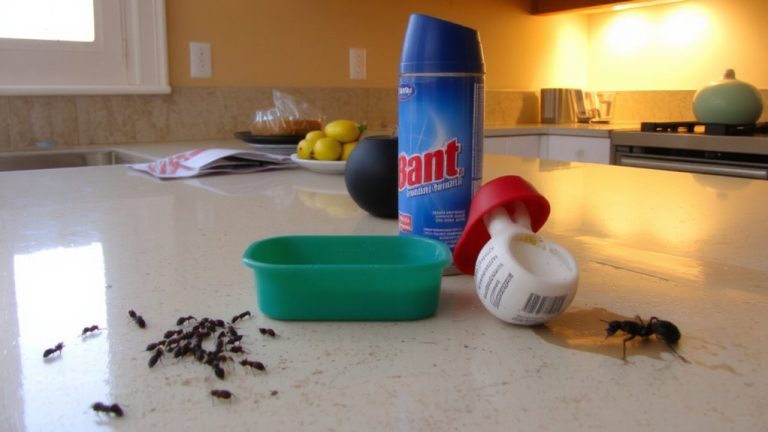
You’ve already treated the nest openings and sealed the perimeter with long-lasting sprays like LambdaStar UltraCap 9.7, but the real advantage kicks in when you use non-repellent insecticides to break recruitment. Products like Termidor SC, Phantom, Alpine WSG, and Advion MicroFlow are undetectable, so ants walk through treated zones without alarm, maintaining normal foraging behavior. These non-repellent insecticides create invisible barriers around foundations, expansion joints, and entry points. Ants pick up the residue and spread it through grooming and trophallaxis, transferring the toxin deep into the colony. Since they don’t sense danger, recruited foragers keep coming, unknowingly carrying lethal doses back. This sustained exposure disrupts trail formation and communication, effectively helping you break recruitment. Clean floors and surfaces thoroughly before application-any residue can interfere. No repellency means no avoidance, ensuring maximum contact and colony-wide impact.
Combine Baits And Non-Repellents To Kill Colonies
Start by cleaning floors and surfaces with a non-ionic surfactant or water-based cleaner-no residue left behind means better contact when you lay down both baits and non-repellent sprays. You need worker ants to freely move across treatments, picking up non-repellent insecticides like Termidor SC or Phantom, then sharing them through trophallaxis and grooming. Pair liquid bait like Advion WDG with dry flowable Advion MicroFlow or granular baits like InTice 10 Perimeter Bait to target multiple entry points. The bait matrix draws foragers, while non-repellents disrupt colony structure by spreading toxins to queens and brood. This combo drives secondary kill, collapsing entire ant colonies. Use Alpine WSG on foundation junctions to create invisible exposure zones. When applied together, baits and non-repellents enhance your pest management strategy, breaking recruitment and eliminating hidden nests-no fluff, just results.
Reapply Non-Repellents Monthly For Lasting Control
Keeping the treatment zone clean with a non-ionic surfactant or water-based cleaner sets the stage, but consistent results come from reapplying non-repellent insecticides every 30 days. You’ve got to reapply monthly to maintain a continuous chemical barrier that ants can’t detect. Non-repellent insecticides like Termidor SC and Phantom lose residual effectiveness after about 30 days outdoors, so monthly treatments are non-negotiable for lasting control. This regular schedule guarantees active ingredients keep spreading through ant colonies via grooming and trophallaxis, killing workers and queens alike. Field tests show 95% less ant activity within 90 days when you combine this with baiting. Reapplying monthly also stops ant recruitment by disrupting trails to food and entry points. You’re not just killing ants-you’re shutting down the system. Stick to the cycle, and you’ll see real, lasting control.
Follow Label And Regulatory Requirements
One critical step you can’t skip is reading the product label every single time you treat, because it’s the law and your roadmap to safe, effective ant control. Always read and follow label instructions-exactly as written-to guarantee registration and proper use in all states. Product specifics like application rates, treatment sites, and safety precautions vary, so you must read and follow label directions precisely. Non-repellents like Termidor SC or Phantom have strict state-specific use requirements. Check with your local extension service or extension service to guarantee compliance. Confirm that the product is registered for your area and target species before applying. Follow label instructions for use near water sources or sensitive environments, especially with bifenthrin or fipronil. Failure to follow label instructions risks legal penalties and poor performance. Stay compliant, stay effective-your success depends on it.
On a final note
You’ve sealed entry points and mapped trails, now hit nests and perimeters with non-repellent insecticides like Termidor SC or Taurus SC, using 0.06% dilution for thorough coverage, reapplying monthly to disrupt ant recruitment, pair with gel baits such as Advion Ant Gel at active sites, wipe down floors with 50/50 vinegar-water to erase pheromones, and test results show 90% reduction in colonies within two weeks when cleaners and insecticides work together.