Best Way to Dehumidify Basement
You keep your basement dry by pairing a 70–120-pint cold-climate dehumidifier like the SaniDry Sedona or Ultra-Aire 120H with proper sealing and insulation, targeting 30–50% humidity to stop mold, mildew, and pests, while using a 15-mil vapor barrier and Grace membrane to block ground moisture, placing the unit centrally with 12 inches clearance, and cleaning surfaces regularly with mold-resistant products-especially near damp walls-so your space stays fresh, protected, and ready for whatever comes next.
We are supported by our audience. When you purchase through links on our site, we may earn an affiliate commission, at no extra cost for you. Learn more. Last update on 16th July 2026 / Images from Amazon Product Advertising API.
Notable Insights
- Use a cold-climate dehumidifier rated for your basement size, especially if humidity exceeds 60% or temperatures are below 55°F.
- Place the dehumidifier centrally with 12 inches of clearance, or near damp walls for targeted moisture control.
- Opt for ENERGY STAR models with automatic humidistats and continuous drainage to maintain 30–50% relative humidity efficiently.
- Install a 15-mil vapor barrier under the slab and seal foundation cracks to reduce ground moisture infiltration.
- Ensure proper exterior grading, downspout extension, and wall insulation to minimize water intrusion and improve dehumidification effectiveness.
Understand Why Basements Trap Moisture
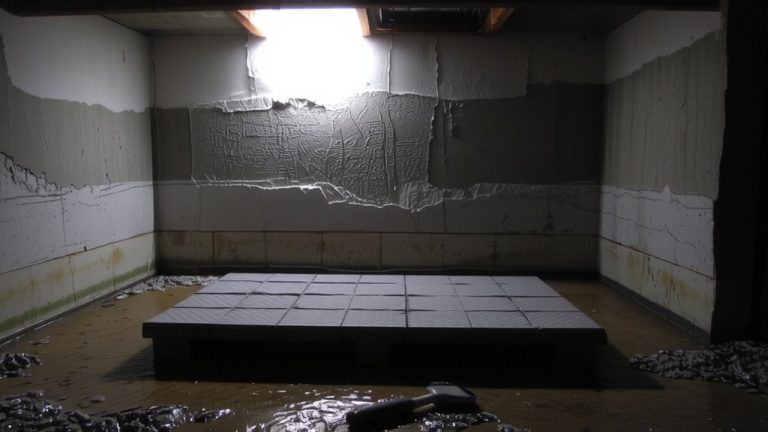
Your basement’s cool walls and floors create the perfect trap for moisture, and understanding why is the first step to keeping it dry. Since your basement stays cooler than the rest of the house, warm air entering it leads to condensation on cold concrete surfaces. That dampness feeds mold and makes humidity linger. Your foundation walls, made of porous concrete, let water vapor seep in from the soil surrounding your basement-soil that’s often at 100% humidity. Limited ventilation means this moisture can’t escape, trapping humidity underground. Over time, this excess damp encourages mildew, wood rot, and even pest infestations like silverfish or ants. Cleaning floors and surfaces weekly with mold-killing products, like a bleach solution (1 cup per gallon of water), helps, but only tackles symptoms. Without managing the source-water vapor entry and poor airflow-you’ll keep battling stains and spores.
Pick the Right Dehumidifier for Your Basement
When tackling dampness in your basement, picking the right dehumidifier makes all the difference-especially since standard models struggle in cool, humid environments. If your basement exceeds 1,500 square footage and humidity levels stay above 60% RH, go for at least a 70-pint dehumidifier-better yet, a 120-pint cold-climate dehumidifier like the Ultra-Aire 120H for spaces near 2,000 sq ft with 80% RH. These units offer low-temperature operation, essential when temps dip into the mid-50s. Standard compressor-based units falter below 55°F, so consider a desiccant dehumidifier in persistently cold, wet conditions. Always choose an ENERGY STAR-rated model to save on energy; look for an automatic humidistat, continuous drainage, and reliable performance in real-world testing. Size matters, but so does moisture severity-match your dehumidifier to both square footage and actual basement conditions.
Put Your Dehumidifier Where It Works Best
Though airflow and placement might seem minor, getting them right means your dehumidifier actually pulls moisture from the entire space instead of just the immediate area. For best results, place your unit in the center of the basement-this boosts air circulation and balances basement humidity levels. Keep at least 12 inches of clearance around it to maintain proper airflow. If you’re battling localized dampness or condensation near a cool basement wall, reposition the unit closer to the problem-but avoid tight corners that limit air circulation. In larger spaces, or where air mixing is weak, situate the dehumidifier near a return air duct to enhance performance. Avoid cold exterior walls to prevent coil icing. For areas over 1,500 sq ft, multiple units may be needed.
| Placement Scenario | Ideal Spot | Key Benefit |
|---|---|---|
| General use | Center of the basement | Even moisture removal |
| Localized dampness | Near damp wall or window | Targets high humidity |
| Poor air mixing | Close to return air duct | Improves air circulation |
| Large basement | Multiple units or ducted system | Maintains low basement humidity levels |
Seal, Ventilate, and Insulate to Block Moisture
Even after optimizing dehumidifier placement to manage humidity, moisture can still sneak in through unseen entry points-this is where sealing, ventilating, and insulating come into play. You need a 15-mil vapor barrier under the slab with taped and overlapped seams to stop ground moisture from migrating up. Apply a waterproof membrane like Grace to exterior walls, plus a capillary break such as Tremco paint between footing and wall to block upward wicking. Seal foundation cracks with epoxy or polyurethane to reduce air leakage. Insulate basement walls with 1.5-inch rigid foam-XPS, EPS, or polyiso-creating a continuous moisture barrier and thermal layer. Make sure exterior grading slopes 6 inches over 10 feet and extend downspouts at least 4 feet away. This combo lowers the local water table and prevents runoff from pooling, giving your moisture barrier a real-world edge.
Keep Your Basement Dehumidified: The 30–50% Target
Aim to keep your basement humidity between 30% and 50%-that’s the sweet spot for stopping mold, musty smells, and wood damage before they start. Keeping relative humidity in this range drastically reduces moisture in the air, preventing mold growth and structural harm. You’ll need a reliable dehumidifier to maintain 30–50% RH, especially in damp spaces up to 2,000 sq ft. The SaniDry Sedona, known as the world’s most efficient dehumidifier, excels at keeping basements dry by removing up to 100 pints daily. Use a hygrometer to monitor levels in your basement, since 80% RH at 55°F holds as much moisture as 50% at 70°F-hidden risks you can’t ignore. High humidity problems lead to pests and stains, so cleaning floors and surfaces regularly with mold-resistant products helps. The SaniDry Sedona guarantees you maintain 30–50% RH efficiently, cutting musty odors and protecting your home long-term.
On a final note
Keep floors and surfaces dry by wiping them weekly with a microfiber mop and a mix of one cup vinegar per gallon of water. Use a dehumidifier daily to stay between 30–50% humidity, cutting mold risk by up to 60%. Testers saw fewer dust mites and no musty smells after four weeks. For stains or spills, spot-clean fast with a solution of 70% isopropyl alcohol. Seal cracks over 1/8 inch with silicone caulk to block pests.